Category agnostic prior for non-rigid shape matching
## Objective ::: columns ::: {.column width="50%"} Hypothesis: We have access to large scale dataset of non-rigid, registered shapes. ::: ::: {.column width="50%"} 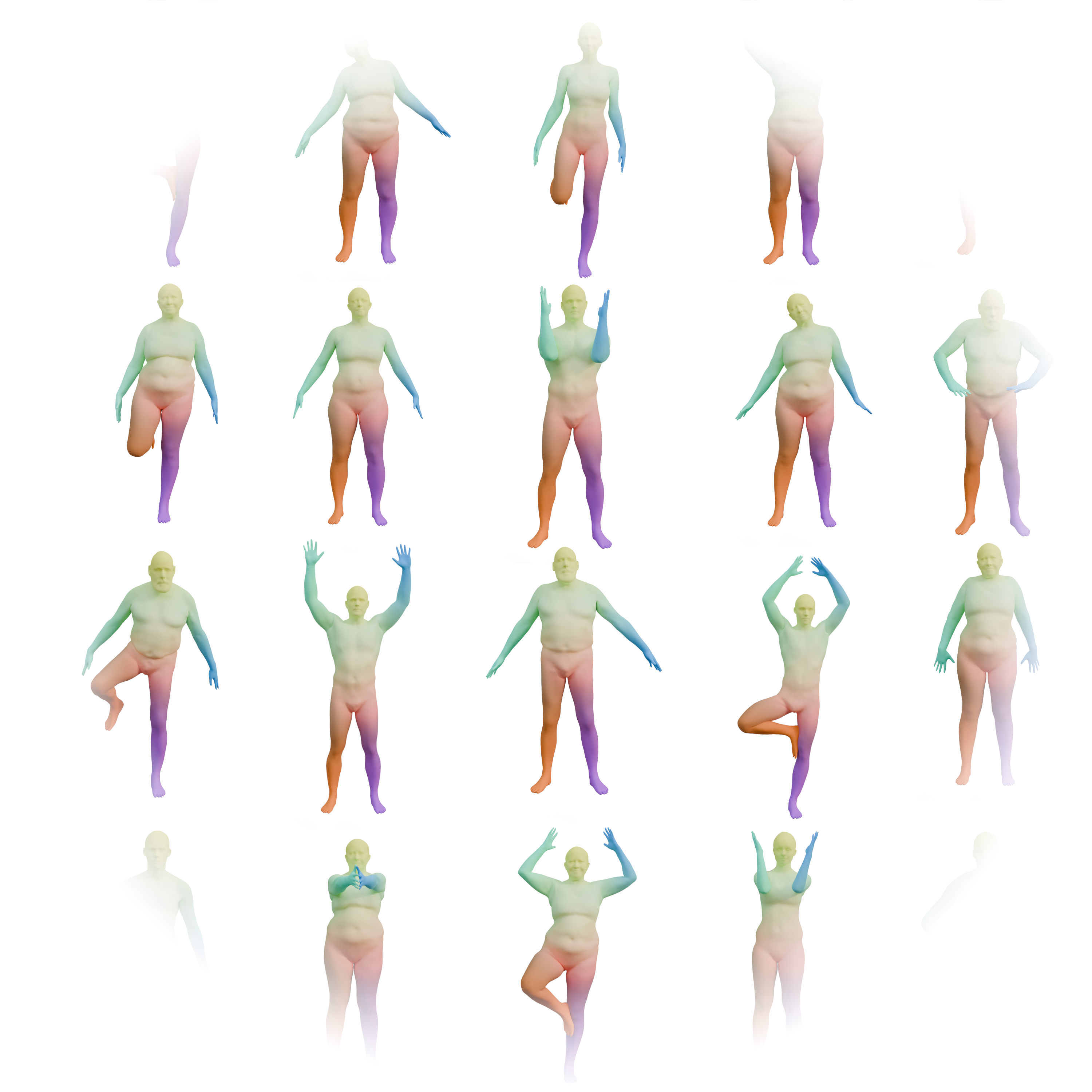{width=350} ::: ::: How can we learn to match shapes, without any hypothesis on the category of shapes we want to match? ## Related work {.smaller} #### Shape deformation ::: columns ::: {.column width="30%"} - Learning latent deformations (3D-CODED) - Add geometric regularization (LIMP, ARAPReg) - Mesh agnostic representations (NJF) **Problem :** The learned deformations are category-specific. ::: ::: {.column width="70%"} 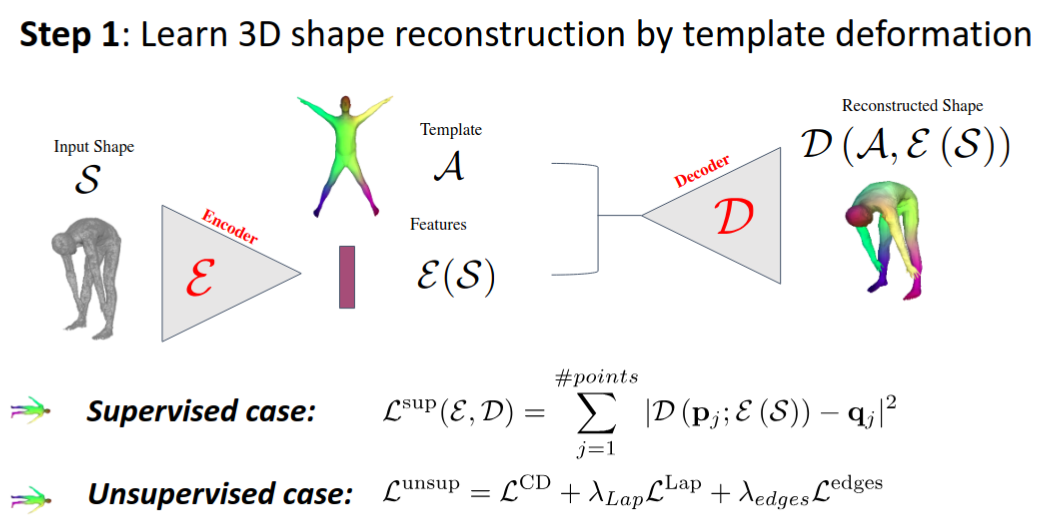 ::: ::: ## Related work {.smaller} #### Shape deformation / shape analysis ::: columns ::: {.column width="30%"} - Shape spaces with guaranteed properties - Can be mesh invariant with geometric measure theory (H2-Match) - Can be mesh invariant by adding learning to shape models (Bare-ESA) **Problem :** Costly optimization or imposes prior to the deformation (when learning). ::: ::: {.column width="70%"} 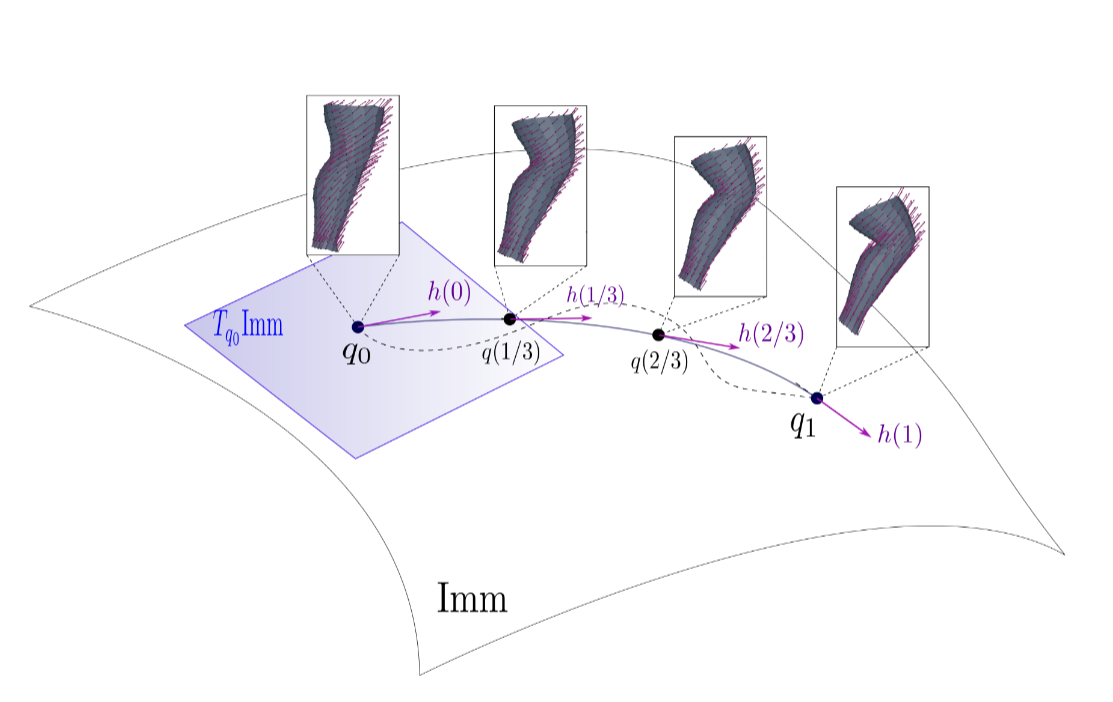 ::: ::: ## Related work {.smaller} #### Shape deformation / shape analysis / shape matching ::: columns ::: {.column width="30%"} - Learning shape descriptors - Use functional maps paradigm to "ease" training - SOTA on matching benchmarks **Problem :** Descriptors are category specific, don't transfer to new ones. ::: ::: {.column width="70%"} 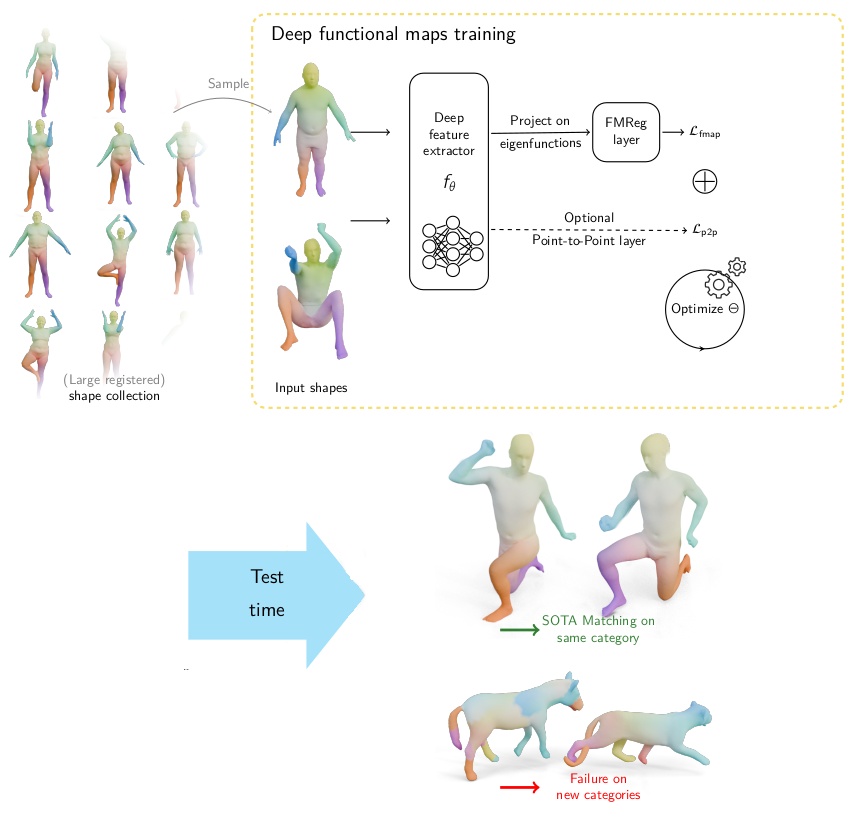{width=450} ::: ::: ## Shape matching with functional maps {.smaller} 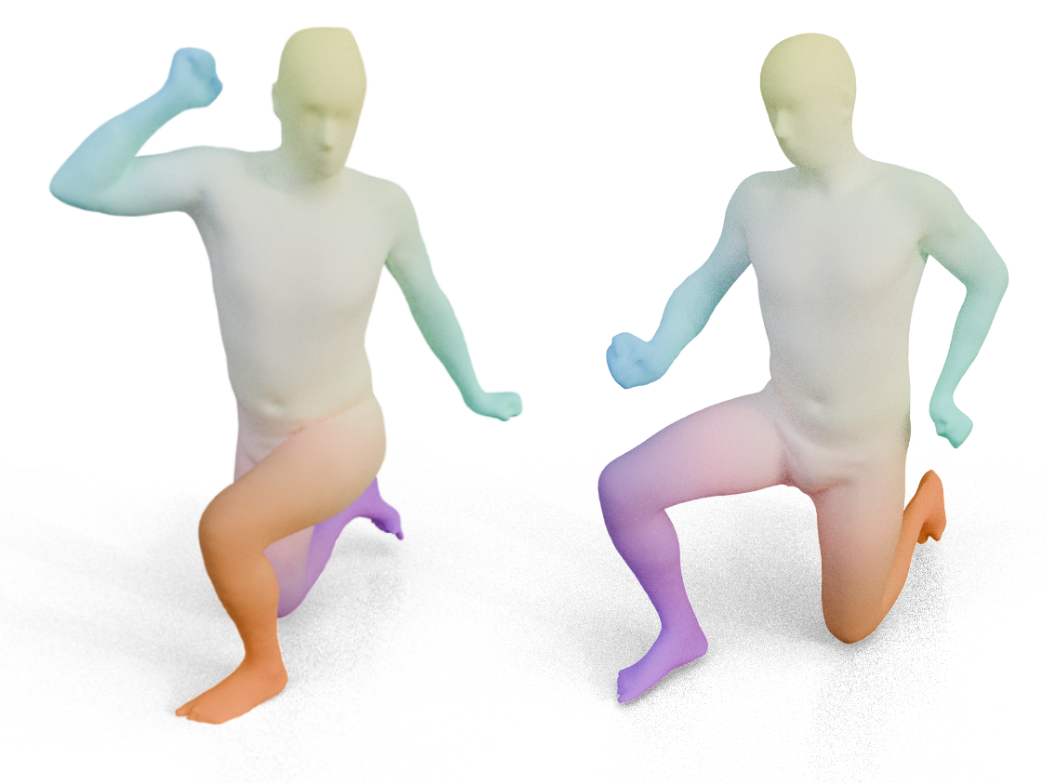 ## Shape matching with functional maps {.r-fit-text} Let $\mathcal{M}$, $\mathcal{N}$ two shapes. We aim to find a pointwise map $T : \mathcal{M} \to \mathcal{N}$ 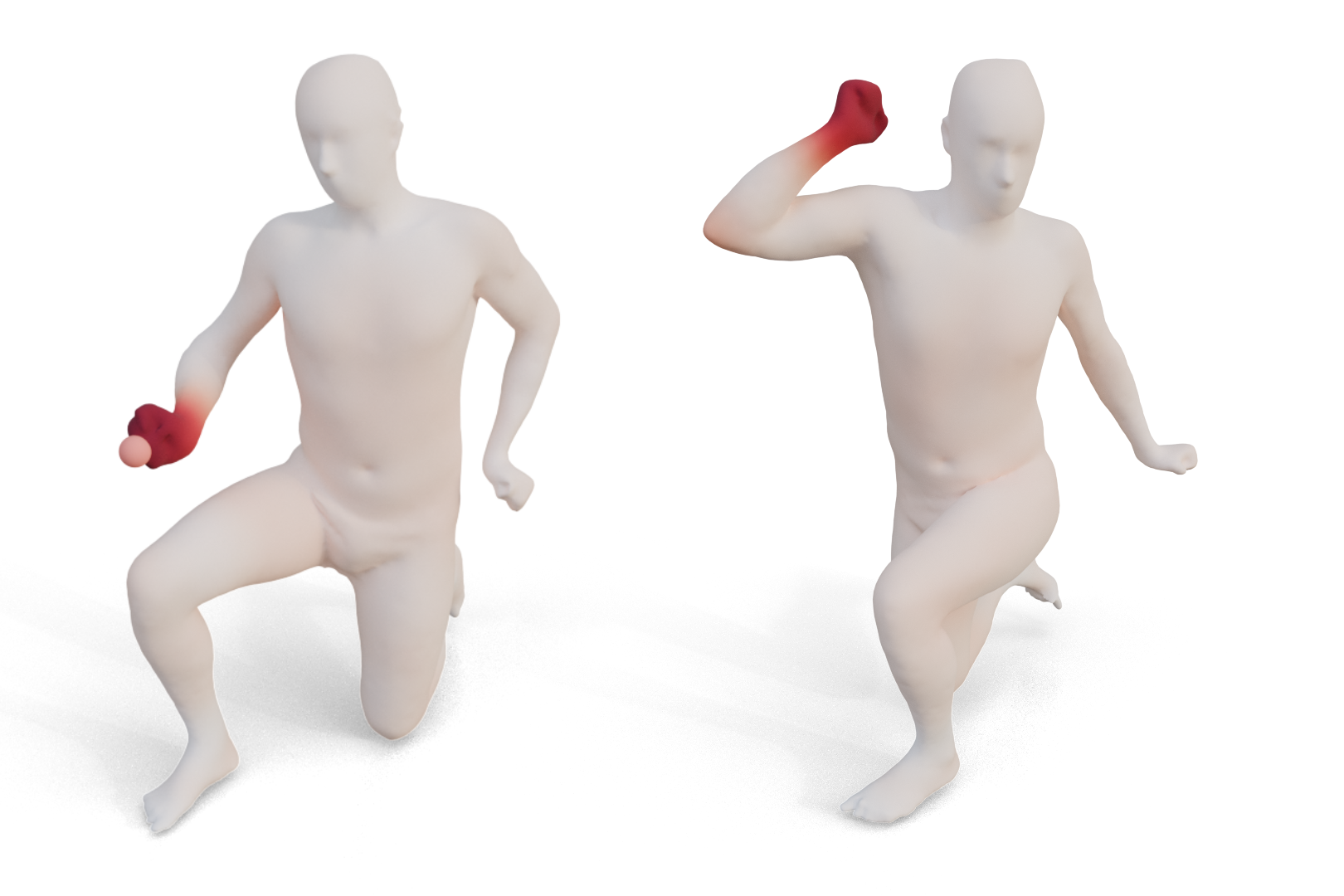 We can also see the pointwise map as a function transfer (here between diracs) ## Shape matching with functional maps {.smaller}  The operator $C: L_2(\mathcal{M}) \mapsto L_2(\mathcal{N})$ is linear! ## Shape matching with functional maps {.r-fit-text} - A set of basis functions (Laplace Beltrami eigenfunctions) on $\mathcal{M}, \mathcal{N}$ - C, represented as a matrix (linear operator) basis function on M and N (note: a mapping matrix $C$ does not necessarily correspond to a pointwise map). - The pointwise map $T$ is then extracted from the mapping matrix. ## Shape matching with functional maps {.smaller } 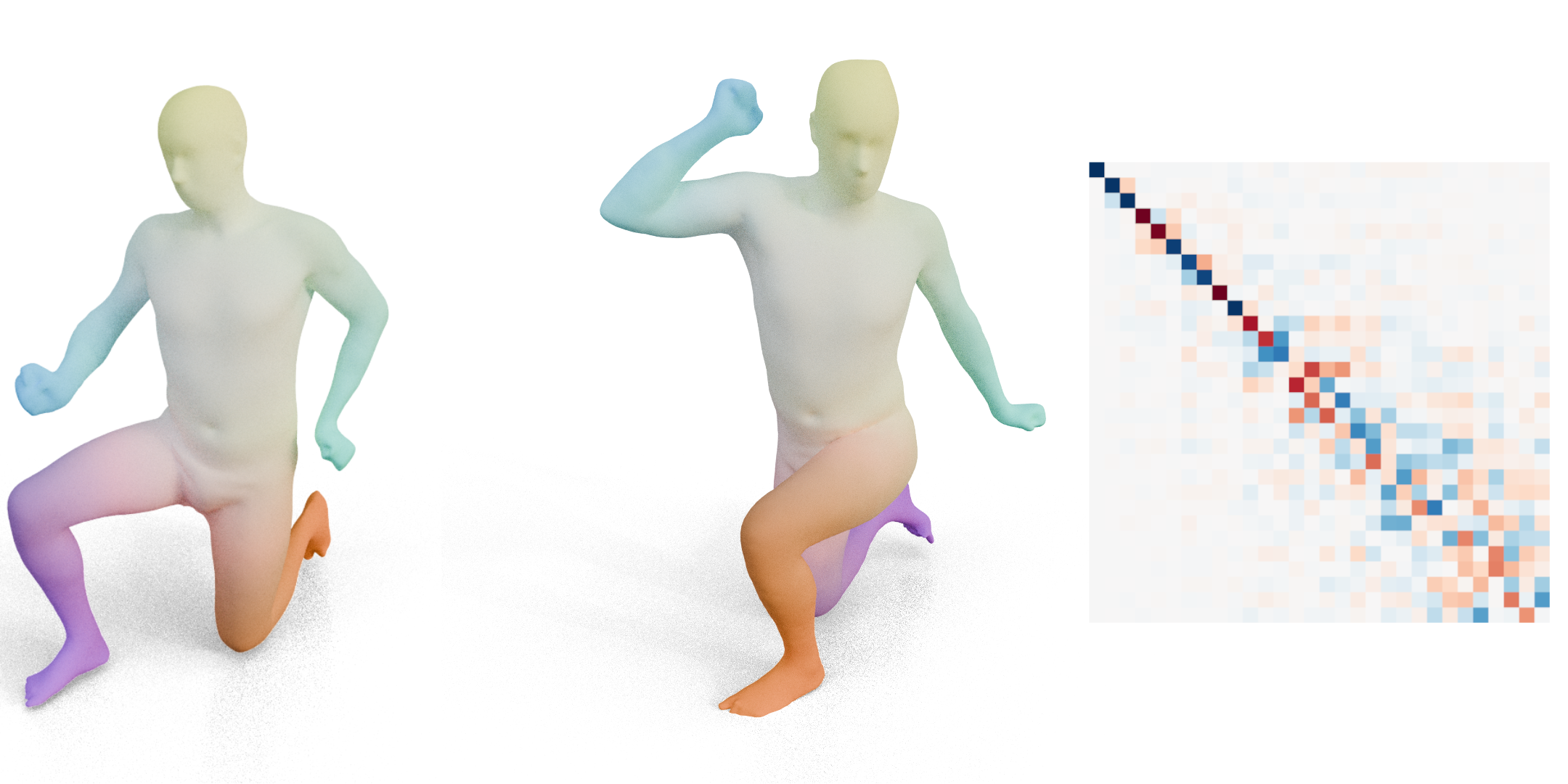 ## Shape matching with functional maps {.smaller} - We have a set of basis functions of $\mathcal{M}$, and $\mathcal{N}$. - We have a set of descriptors functions $f_i$ on $\mathcal{M}$ and $g_j$ on $\mathcal{N}$ such that $g(x) \sim f \circ T^{-1} (x)$. - We decompose all $f_i$ as $a \in \mathbb{R}^{n \times m}$ and $g_j$ as $b \in \mathbb{R}^{n \times m}$. The functional map can be defined as the solution of: $$ C = \underset{C}{\text{argmin}} ||Ca - b||² = \underset{C}{\text{argmin}} \text{ data_loss(C)} $$ In practice, we compute the pointwise descriptors using a neural network. Since the output of the previous equation can be obtained in closed form, we optimize the output $C$ with respect to the ground truth map $C_{gt}$ or with axiomatic constraints, allowing to learn the descriptors. ## {.smaller} ### Deep Functional maps regularization terms - "Maps should be as isometric as possible" (can be incorporated in FMReg layer, key for initialization [NCP, Neurips 2023]): $$|| M_{\text{LBO}} * C ||^2$$ - "Maps should be volume preserving": $$|| C C^T || ^2 $$ - and many others (continuity, orientation, bijectivity, ....) However, those conditions are not always met in practice. ## Deep functional maps 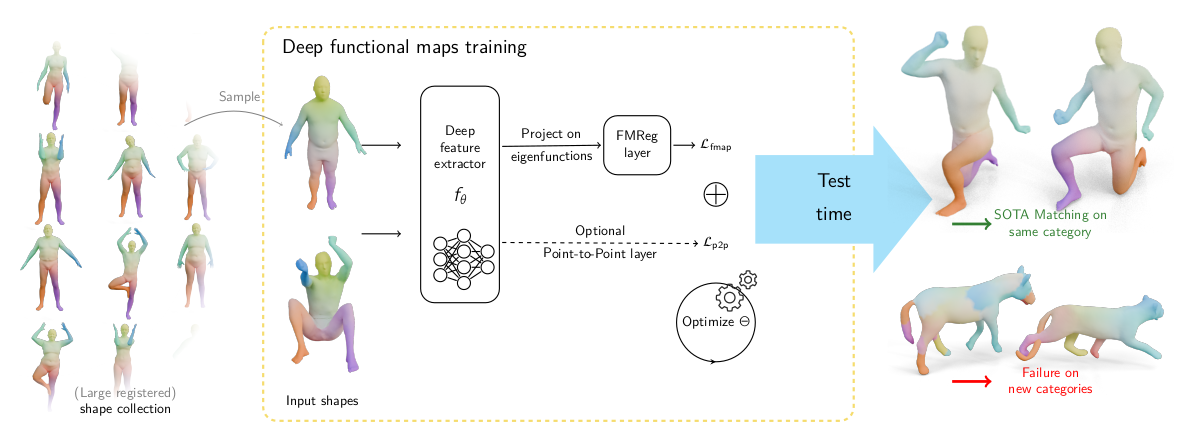{.r-stretch} Note: the loss looks like $\text{ data_loss(C)} + \text{reg_loss(C)}$. ## Experiment Functional maps exhibit similar diagonal structures across humans, animals, and other categories. 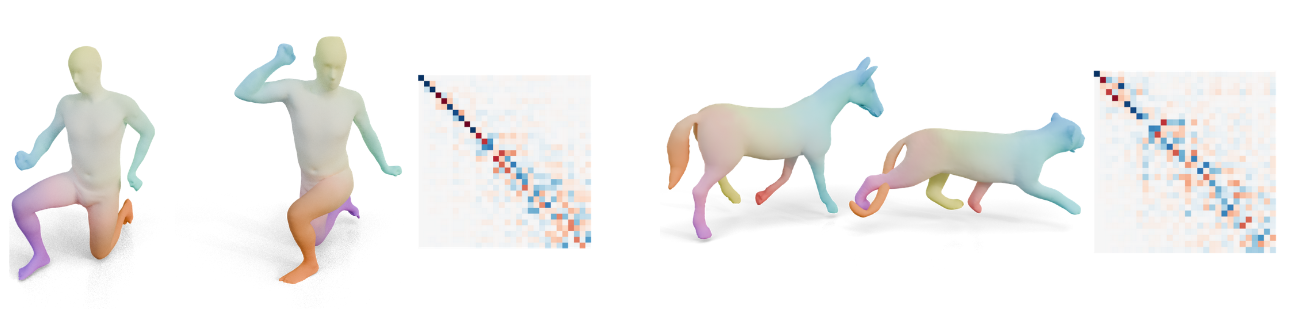 Can we "learn" this structure? ## New objective Hypothesis: We have access to large scale dataset of non-rigid, registered shapes. How can we learn a prior on functional maps, to regularize deep functional maps, without any hypothesis on the category of shapes we want to match? Answer: diffusion models! ## Diffusion models 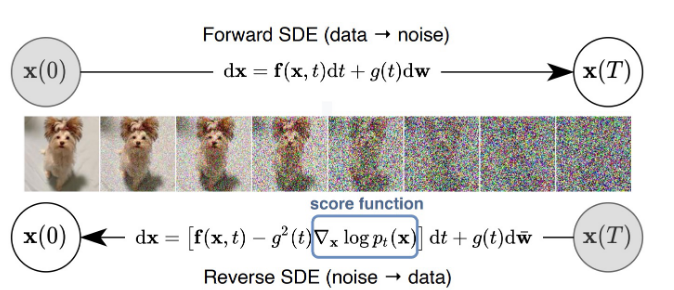 ## Diffusion models {.r-fit-text .smaller} - Forward SDE ($t: 0 \to 1$) (*data to noise process*): $$dx_t = h_t(x_t) dt+ g_tdw$$ - Reverse SDE ($t: 1 \to 0$) (*generative process*): $$dx_t = \left(h_t(x_t) - g_t^2 \nabla_{x_t} \log p_t(x_t) \right)dt +g_t d\bar{w}$$ $s(x_t, t) = \nabla_{x_t} \log p_t(x_t)$ is the score function (what we need to estimate). (We can condition the score function $s(x_t, t, c)$ on any condition $c$ e.g. text.) https://yang-song.net/blog/2021/score/ ## ### Score function: langevin dynamics Score function is $s(x) = \nabla_x \log p(x)$. By iteratively following the score and adding a little noise, we are generating samples !! 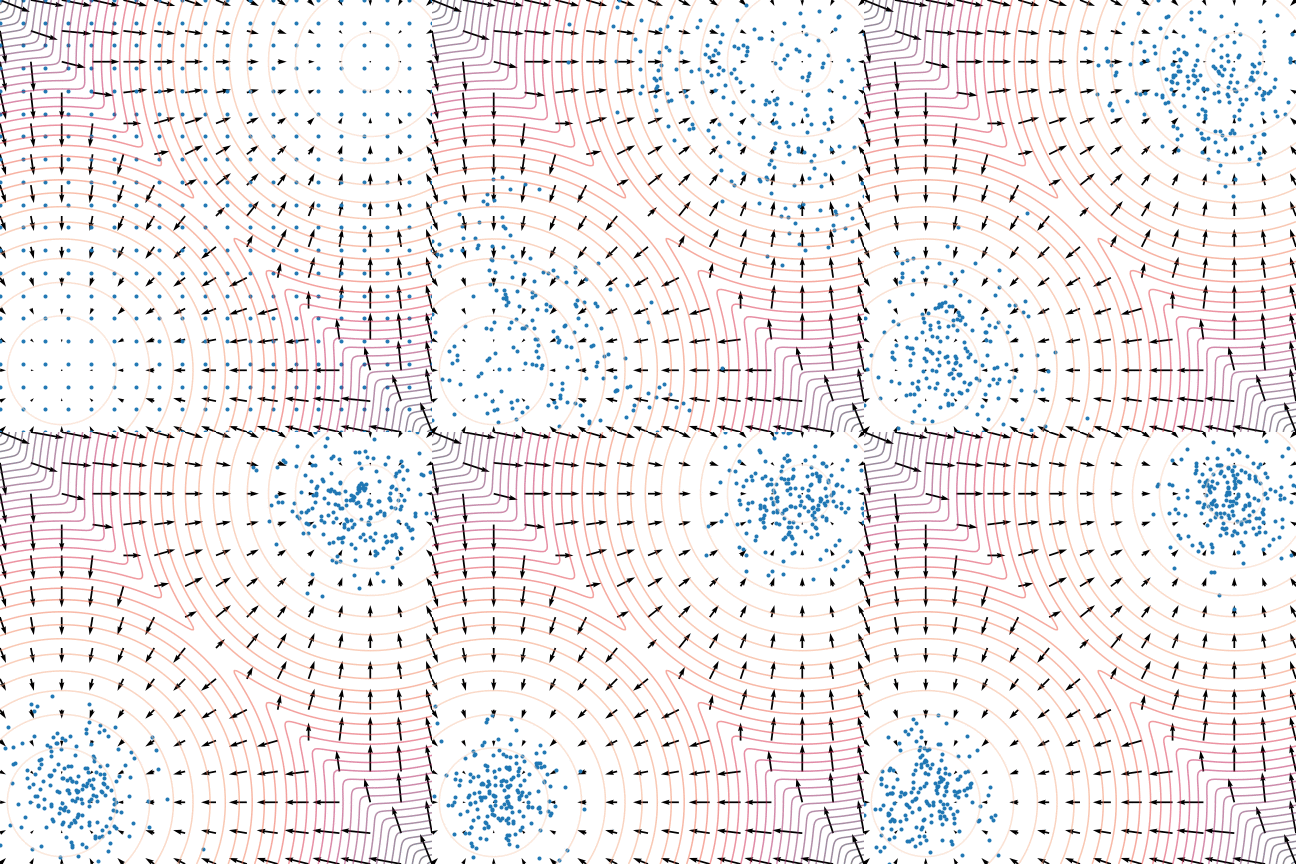{.r-stretch} ## ### Score matching 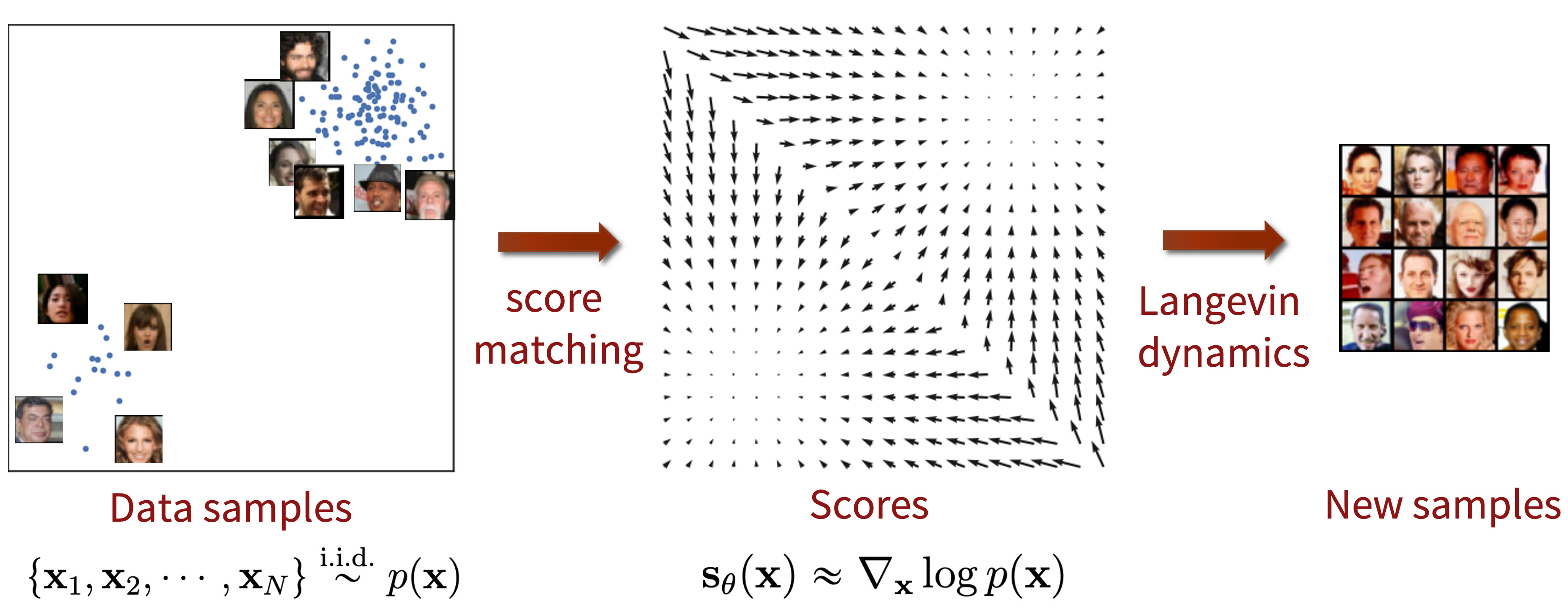 ## ### Why we need a little more Out of the data distribution, we don't need the score. However, it is where the score is the highest! 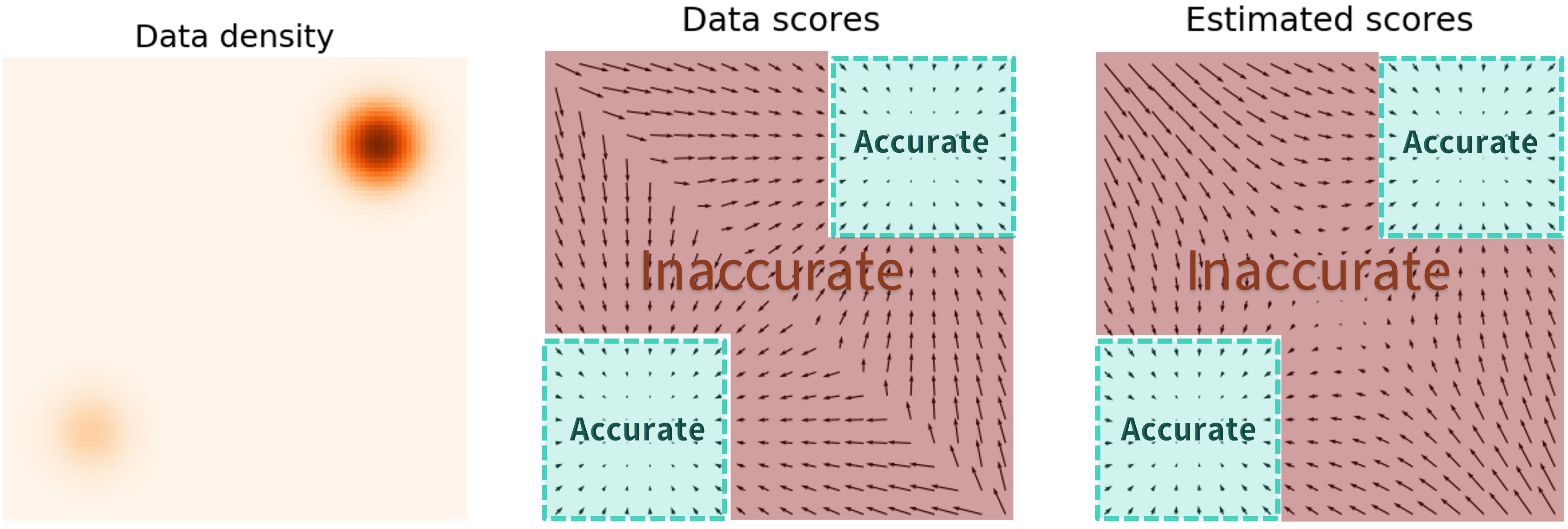 ## ### Denoising score matching: ### Perturbed noise distributions By using different noise scales, we can estimate the score easily out of the data distribution. 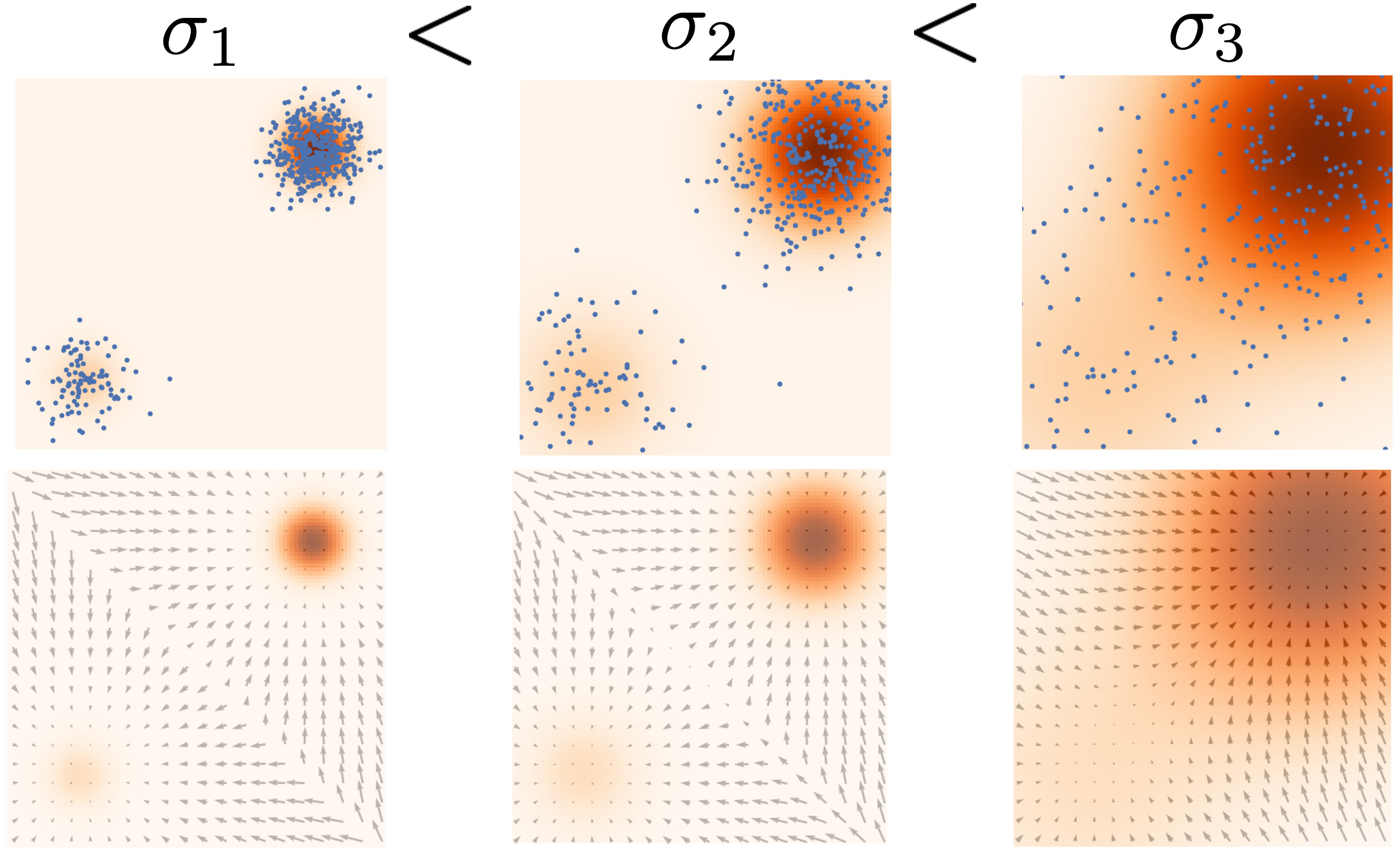{.r-stretch} ## ### Denoising score matching: ### Annealed langevin dynamics We can reproduce a better langevin dynamics by iteratively denoising. 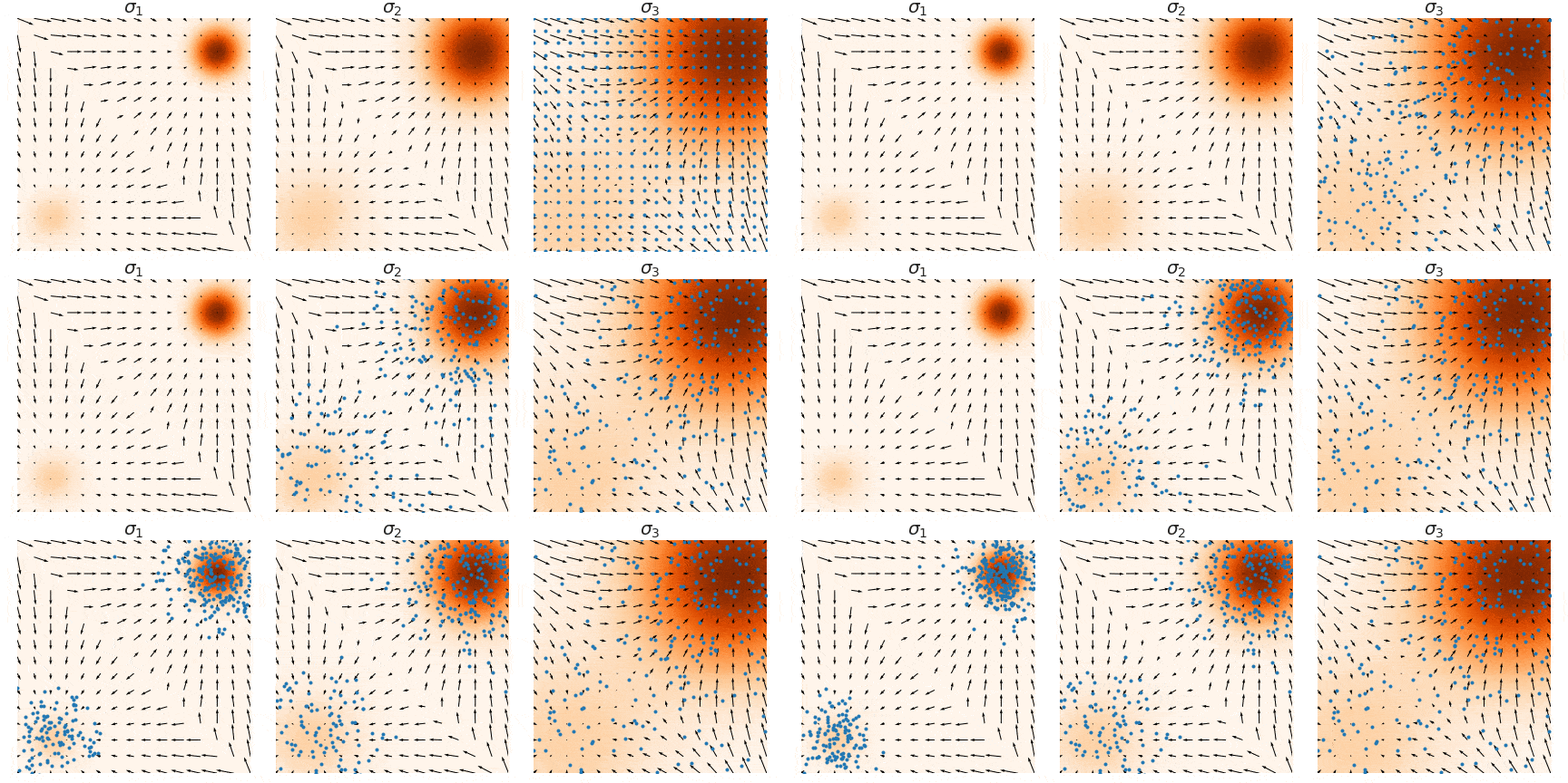 ## ### Denoising score matching: ### Practical 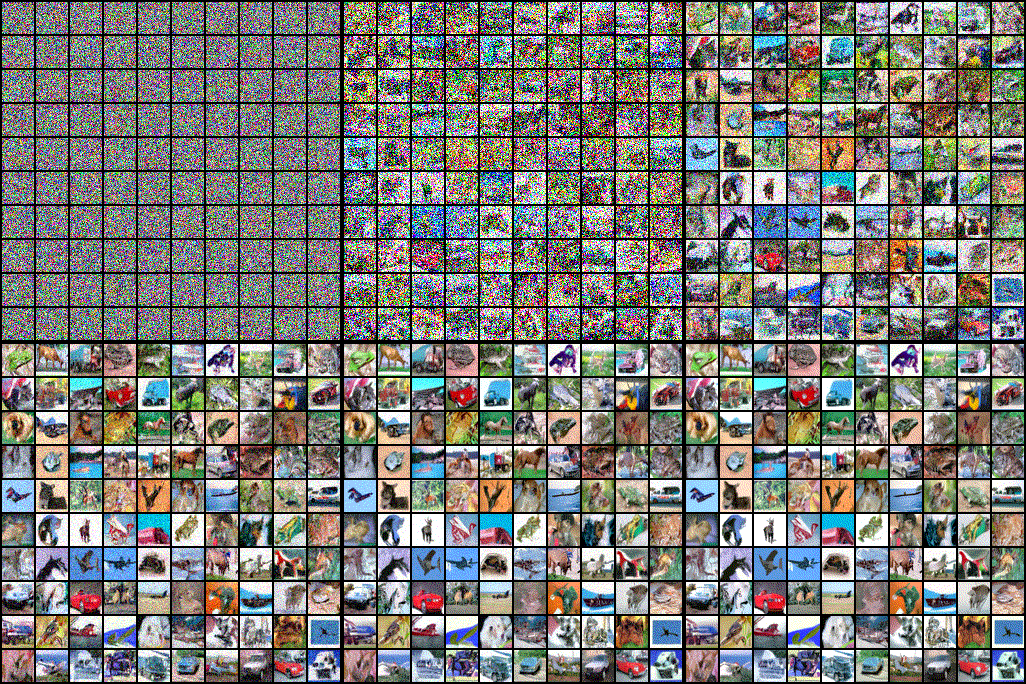 ## Diffusion models {.r-fit-text} In general, learning to denoise the data $x_t$ is sufficient using a denoiser $D_\psi(x_t, t)$, minimizing $$ \mathbb{E}_{x \sim p_{\text{data}}} \mathbb{E}_{n_\sigma \sim \mathcal{N}(0, t^2 I)}|| D_\psi(x + n_t, t) - x ||^2,$$ where $\psi$ are parameters (neural network weights). Then, the score function is given by: $$\nabla_{x_\sigma} \log p({x_\sigma}; \sigma) = (D({x_\sigma}; \sigma) - x)/\sigma^2$$ ## Diffusion models {.smaller .r-fit-text} ### Summary - Noising process, denoising - generative process - Denoising $\sim$ following the score using Annealed Langevin dynamics - Learing the score $\sim$ learning to denoise - Learning to denoise $\sim \sim \sim$ learning the data probability density **Sounds like a good candidate for our task** How can we transfer our knowledge of data probability to downstream tasks? ## Score Distillation Sampling ### Main idea  ## Score Distillation Sampling ### Main idea ::: columns ::: {.column width="70%"}  ::: ::: {.column width="30%"}  Text-to 3D generation ::: ::: ## Score Distillation sampling {.medium-small} ### Details We have a **source domain** (with lots of training data) and a **target domain** (with not so much training data) such that: - We have a denoiser $D_\psi$ on the source domain (easy) - We have a **differentiable representation** $y_\theta$ on the target domain. - We have a **differentiable "source domain extractor"** $g(y_\theta)$ that maps the target domain representation to a source domain representation We want to sample $y_\theta$ with the learned denoiser ## Score Distillation sampling {.medium-small} ### On text-to-3D - Our **source domain** is images - Our **target domain** is 3D shapes - Our **differentiable representation** is a NerF (original paper) or 3DGS - Our **differentiable extractor** is rendering. ## Score Distillation sampling {.medium-small} ### On deep functional maps - Our **source domain** is functional maps (trained with human registered data) -> we train a Denoiser $D_\psi(x_t, t)$ on human data functional maps - Our **target domain** is point-to-point maps - Our **differentiable representation** is pointwise features of deep functional maps - Our **differentiable extractor** is functional maps block We can now transfer functional maps knowledge accross categories with SDS!! Let's do it ## Score Distillation sampling {.smaller} ### On deep functional maps  We can now transfer functional maps knowledge accross categories with SDS!! Let's do it ## Diffumatch 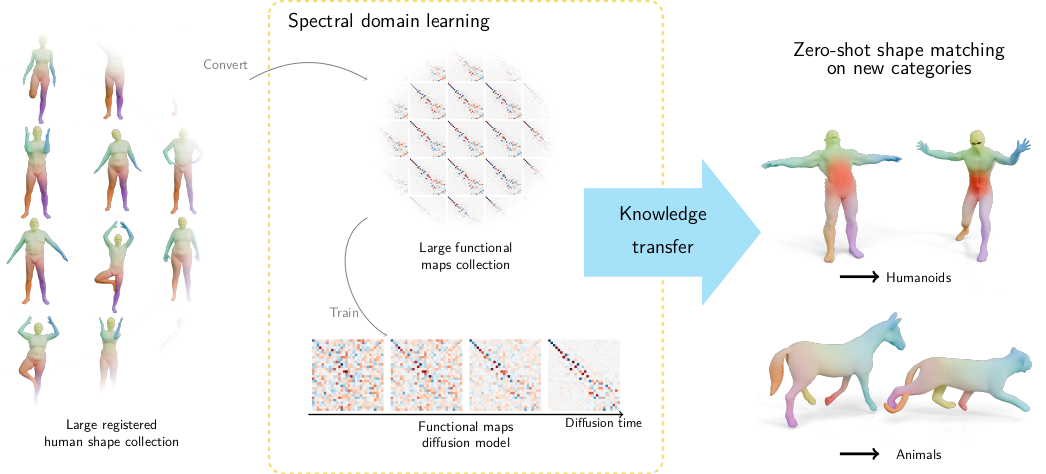 ## Score Distillation Sampling {.smaller} "When it sounds too good to be true, very often, it is too good to be true" 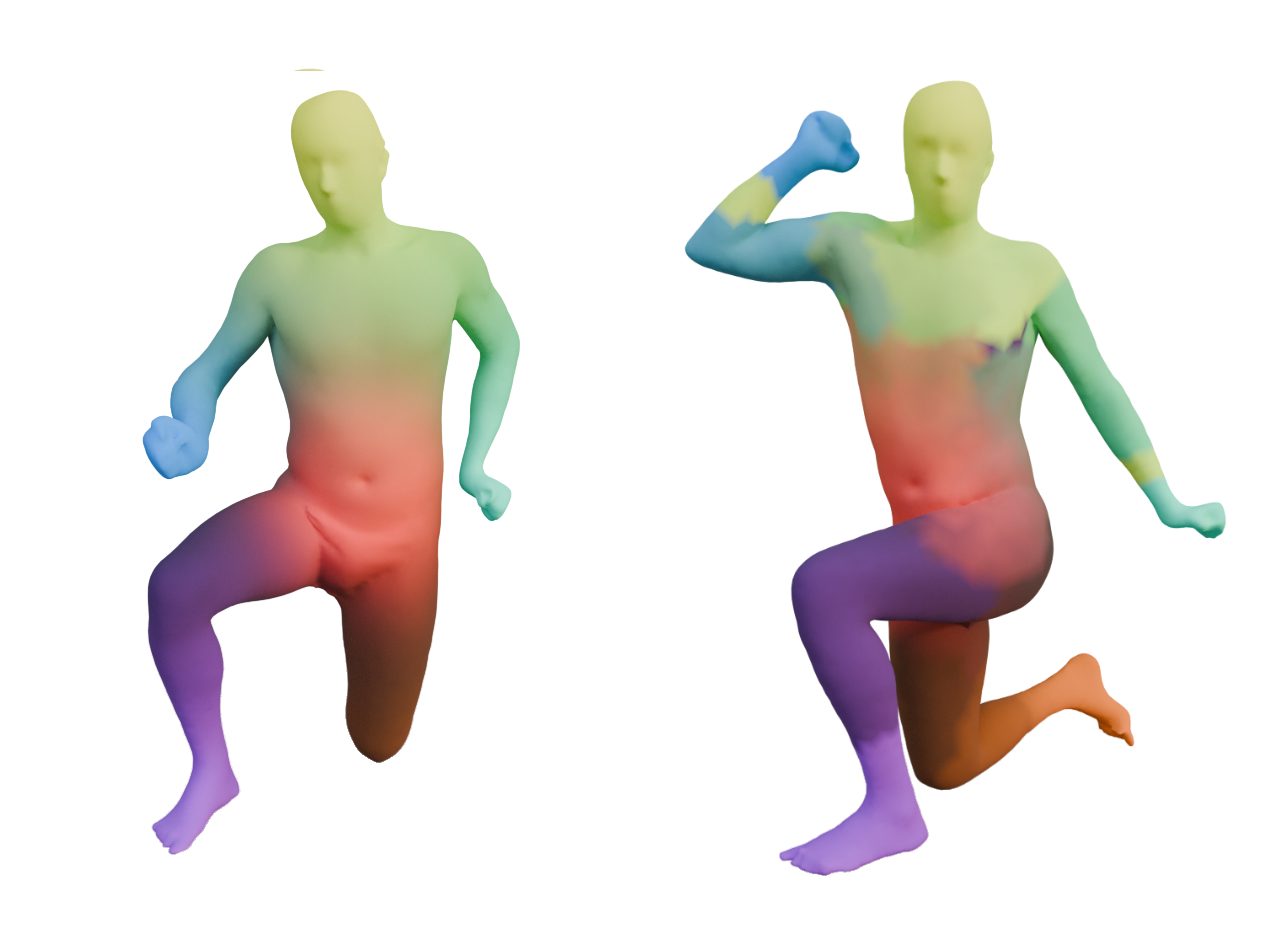 ## Diffumatch We just applied SDS as-is, but ignored completely that we are computing functional maps. We have to: ::: {.incremental} - Make sure the initialization is correct. - Trick: compute a learned mask regularization from the score denoiser -> better initialization. - Make sure the functional maps correspond to a point-to-point map ::: ## Mask vizualization 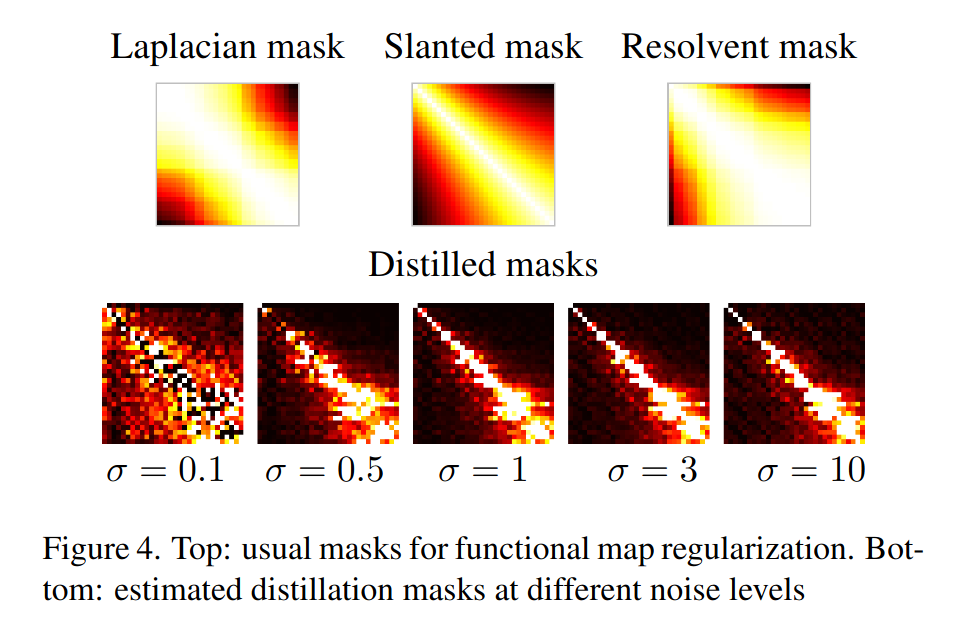 ## Results 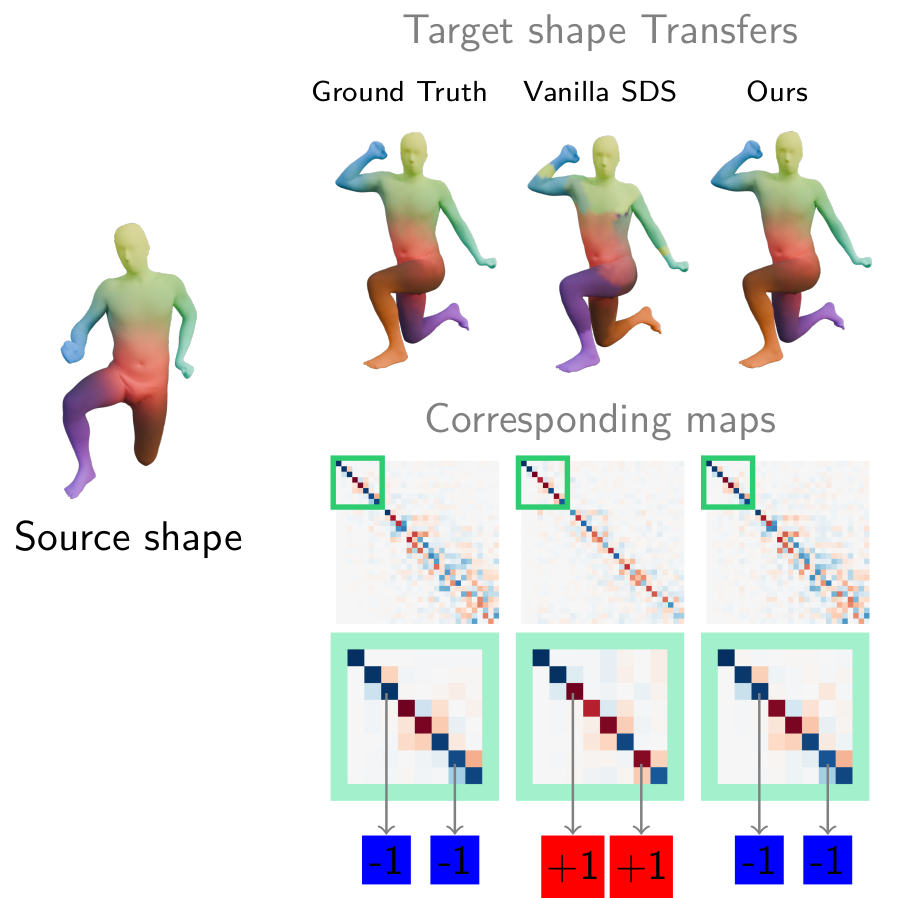 ## Diffumatch final pipeline 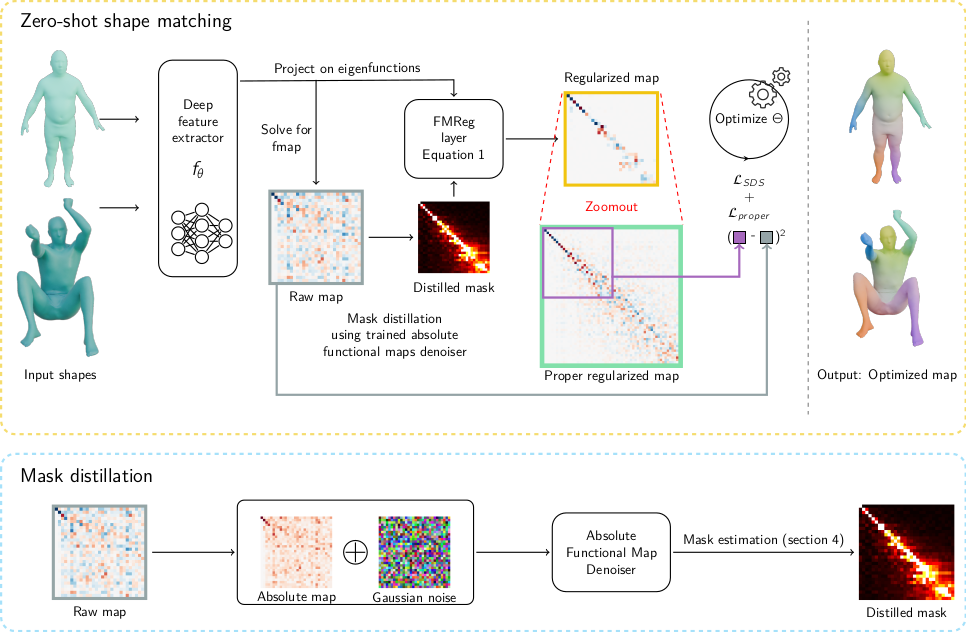 ## Some results 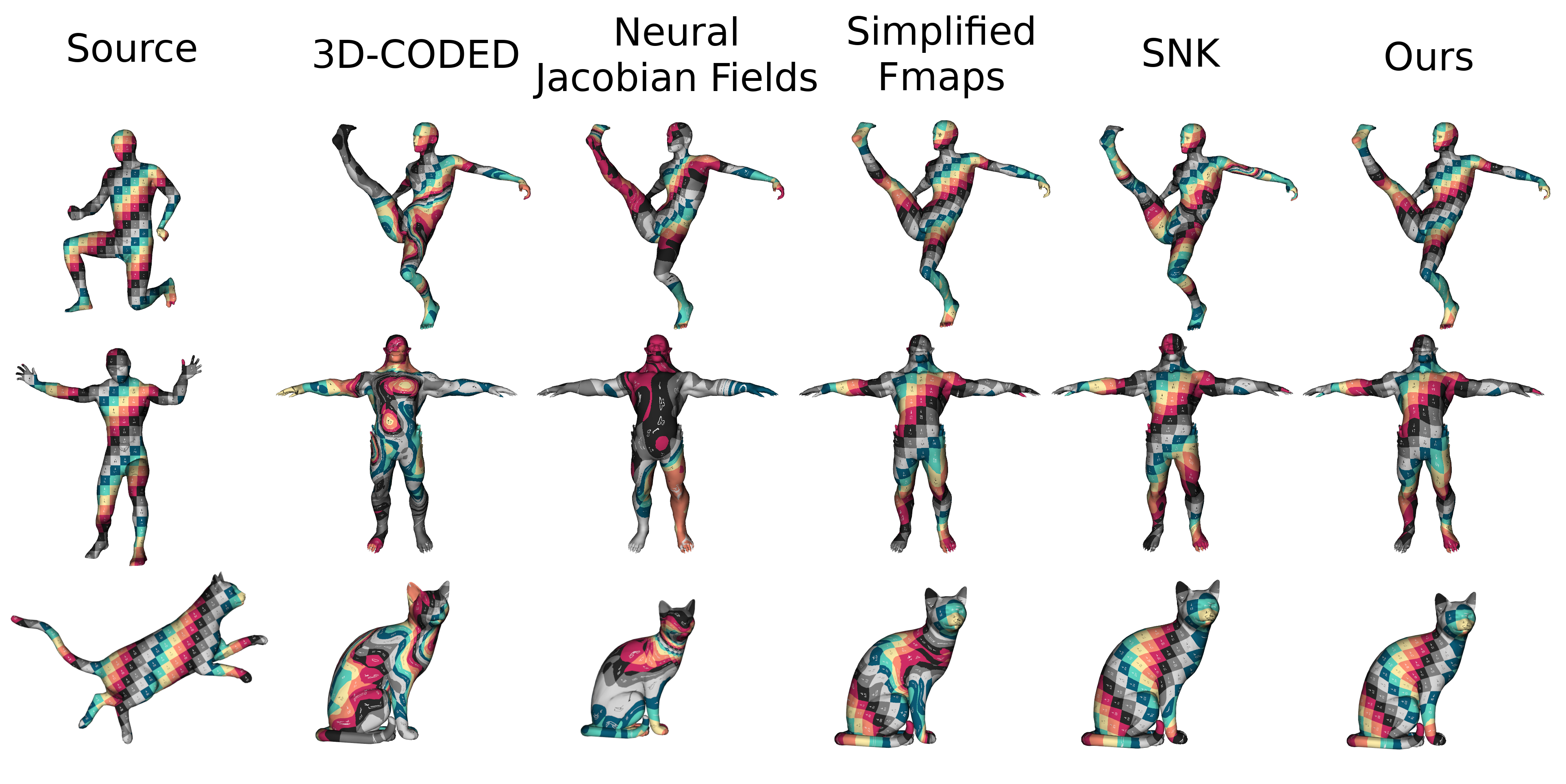 ## Generalization 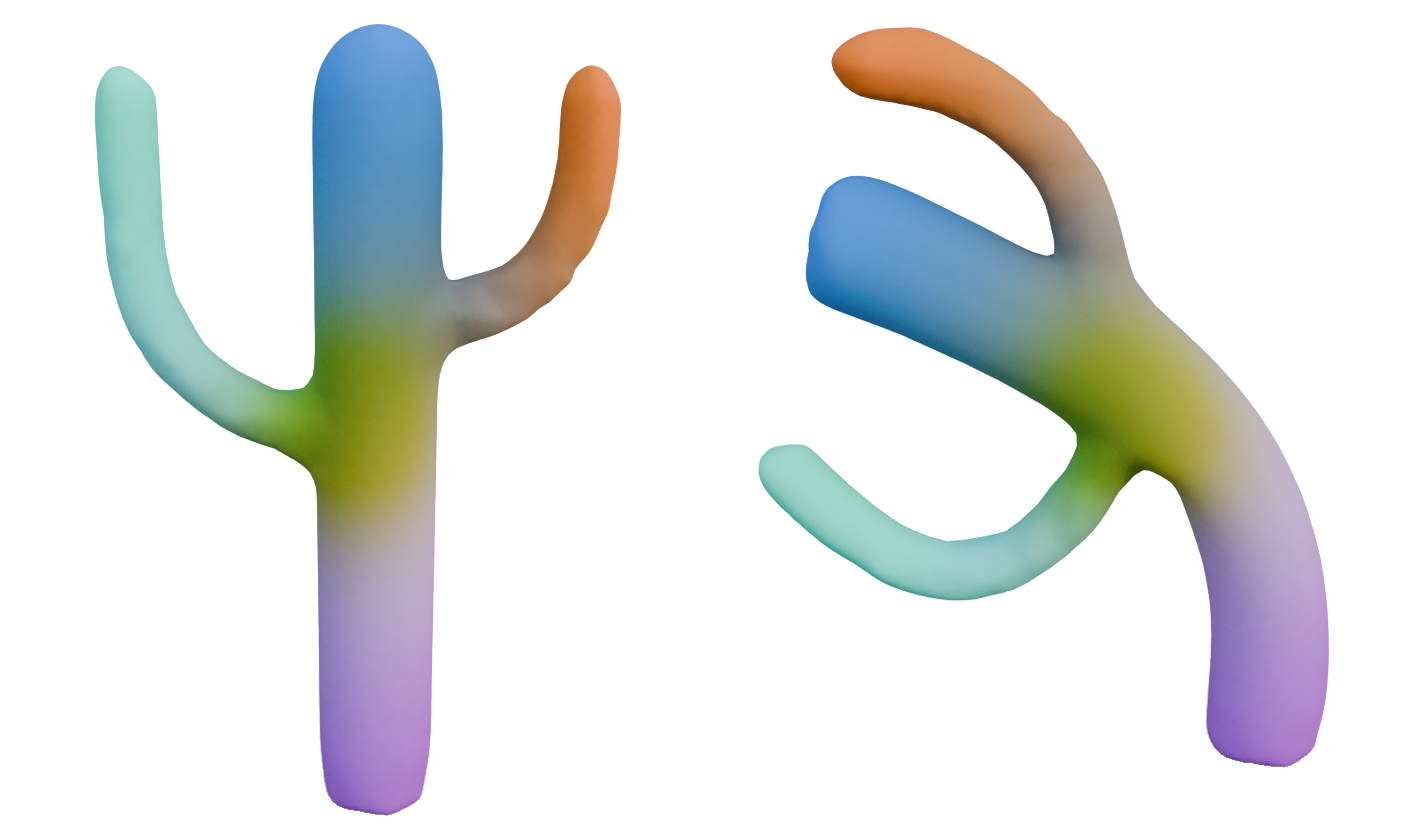 ## Limitations 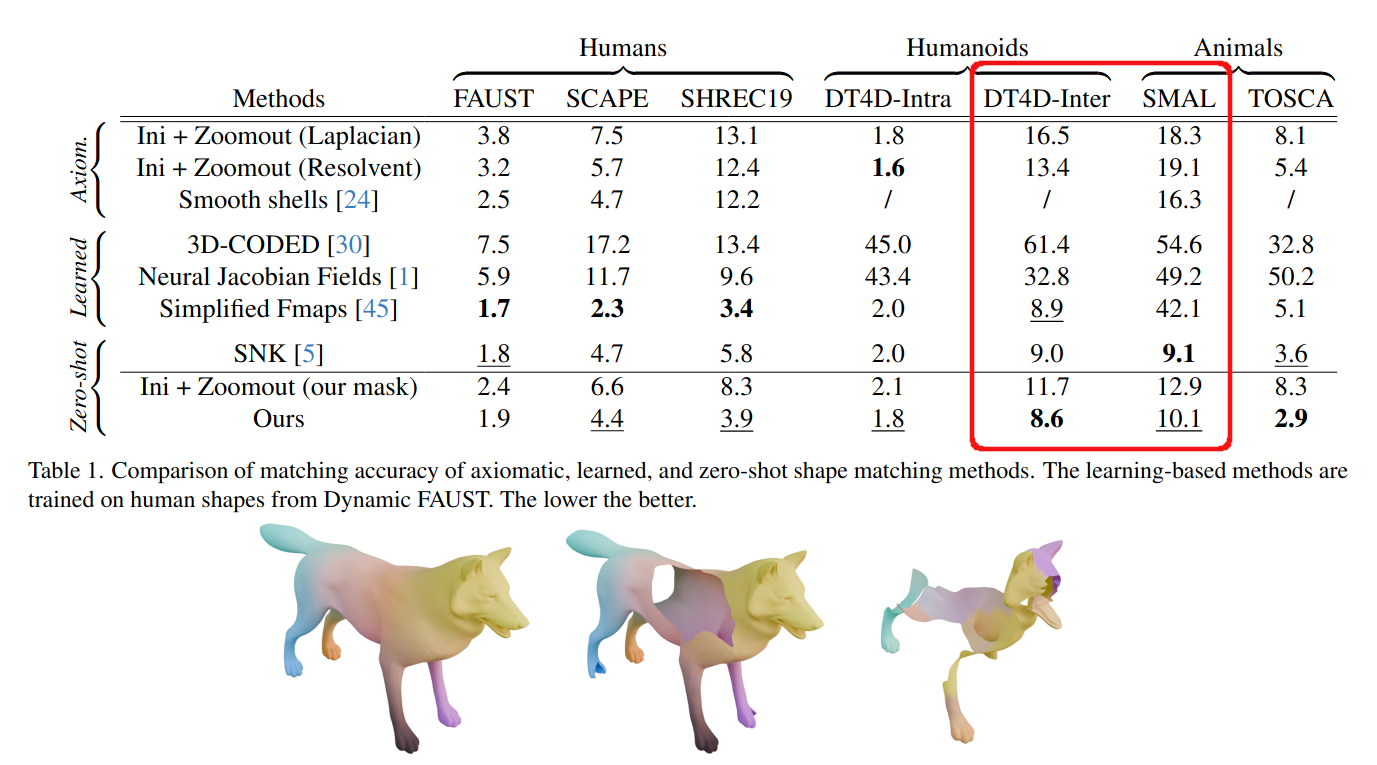 ## Take-aways {.r-fit-text} - Functional maps, by nature, are good candidate for category agnostic learning - Recent technology (diffusion models, SDS) is important, even for geometry - Applying it to new domains require some domain knowledge ## Future works - We only trained our diffusion model on humans. Can we improve the generalization with more data? - Are functional maps **really** the best candidate? - First potential candidate: Surface general features / distillation from image features. - Endgoal: foundation model for 3D shape matching/analysis. ## PatchAlign3D ::: columns ::: {.column width="50%"} Our main limitation is the lack of 3D/surface general features. Ideal: Dino/CLIP for 3D. Limitation: limited 3D training data? Can we learn 3D features that are close to 2D features? ::: ::: {.column width="50%"} 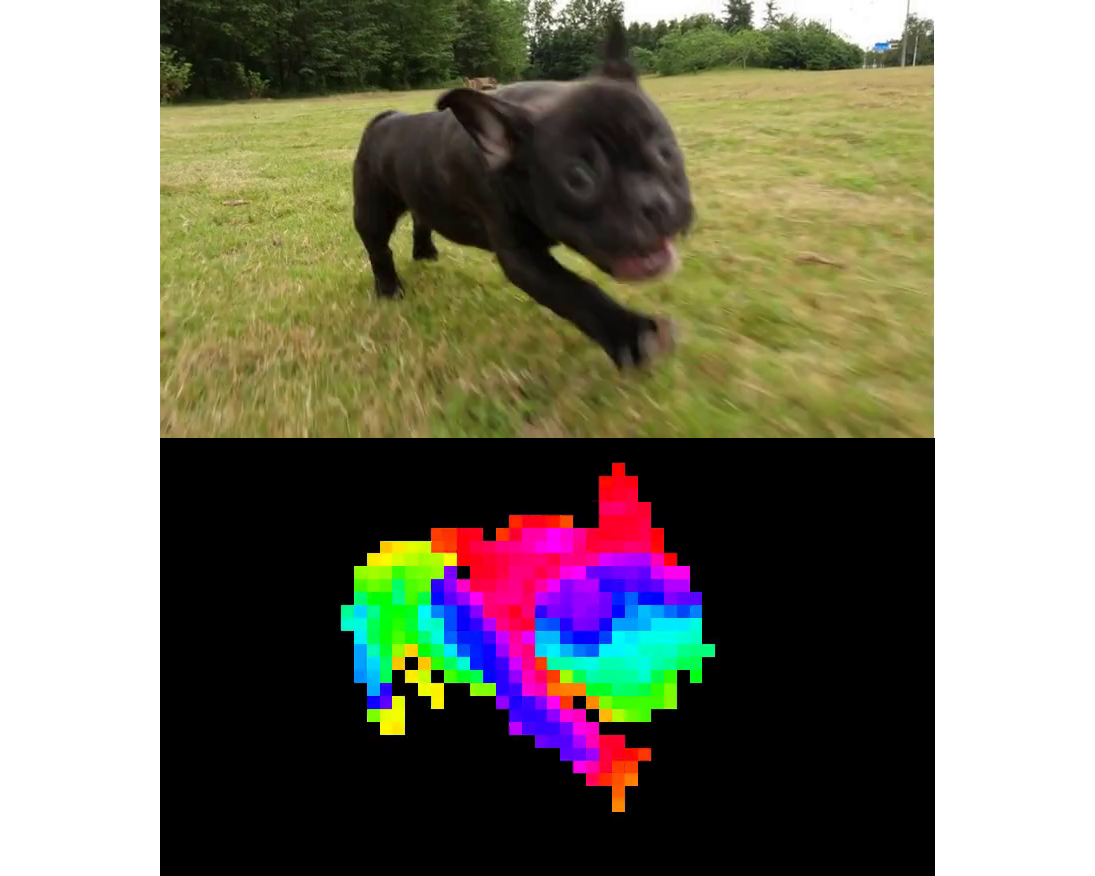{width=350} ::: ::: ## Solution Distill DinoV2 features!! 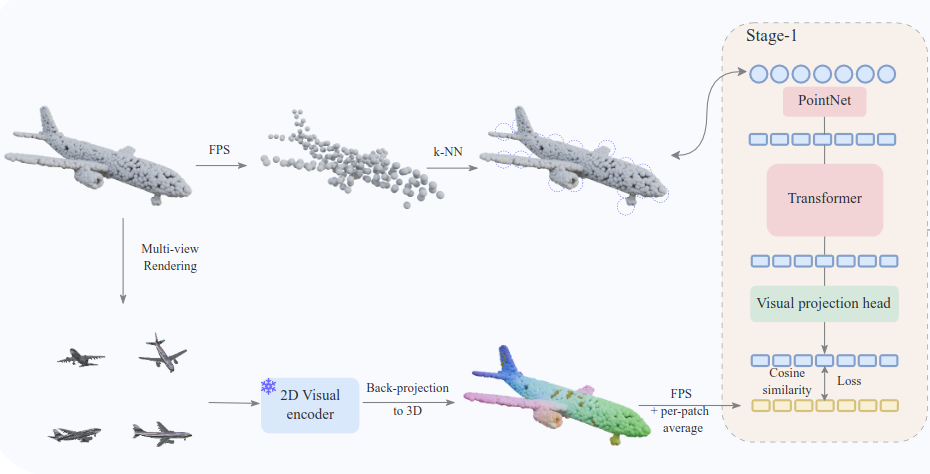{.r-stretch} ## Breakdown ::: {.incremental} - Predict features on patches as for images - Use a transformer à-la Vision Transformer - Distill 2D features from rendering + backprojection. - For open-text segmentation, contrastive loss between distilled features and text features ::: ## Results 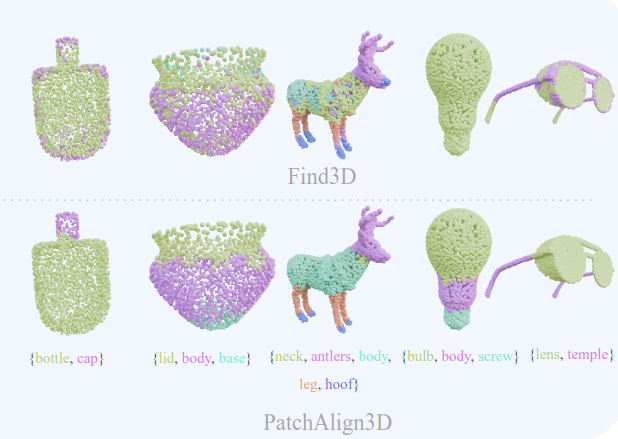{.r-stretch} ## Conclusion ::: {.incremental} - First steps towards 3D shape matching models: good features (patchalign3d) and correspondence prior (diffumatch). - Can we improve features with a surface network? - Can we improve the prior (more training data, deformation prior, better architecture) - Can we predict shape matching in a feed-forward way? ::: ## Score Distillation sampling ### Details This is done by minimizing the loss: $$ \nabla_\theta \mathcal{L}_{\text{SDS}} = \mathbb{E}_{\sigma, x_t \sim \mathcal{N}(x, t)} [(x_t - D(x_t, t))/t] \frac{\partial g}{\partial \theta},$$ where $x = g(y_\theta)$. In the original paper, $y_\theta$ is the Nerf representation, $g$ is the differentiable rendering, $x$ is an image.